Polyurethane timing belts outperform rubber timing belts in dimensional stability, chemical resistance, and service life under continuous-duty industrial conditions — but rubber timing belts remain the superior choice for high-temperature environments, automotive engines, and applications requiring vibration damping. The decision between the two materials is not simply a question of which is "better" but which is better suited to the specific load, temperature, chemical exposure, and duty cycle of the application. Getting this choice wrong results in premature belt failure, costly downtime, or safety incidents in precision drive systems.
Both belt types share the same synchronous drive principle — meshing teeth on the belt engage with matching grooves on the pulley to transmit motion without slip — but the material from which the body, tooth compound, and tension cord are made creates measurable differences in every performance category. This article quantifies those differences so engineers and buyers can make a defensible selection.
Material Composition: What Each Belt Is Actually Made Of
Rubber Timing Belt Construction
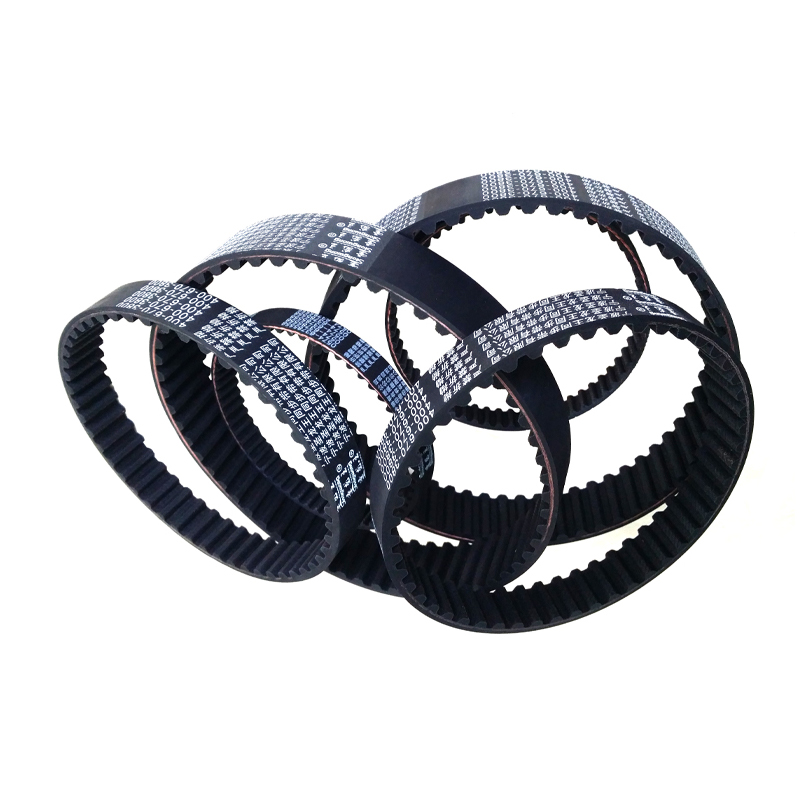
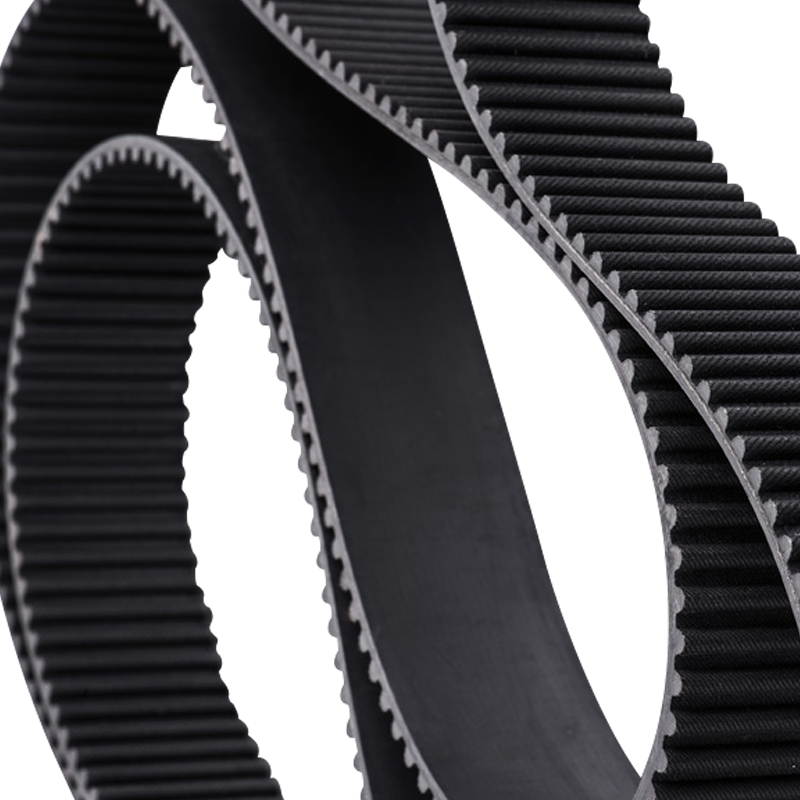
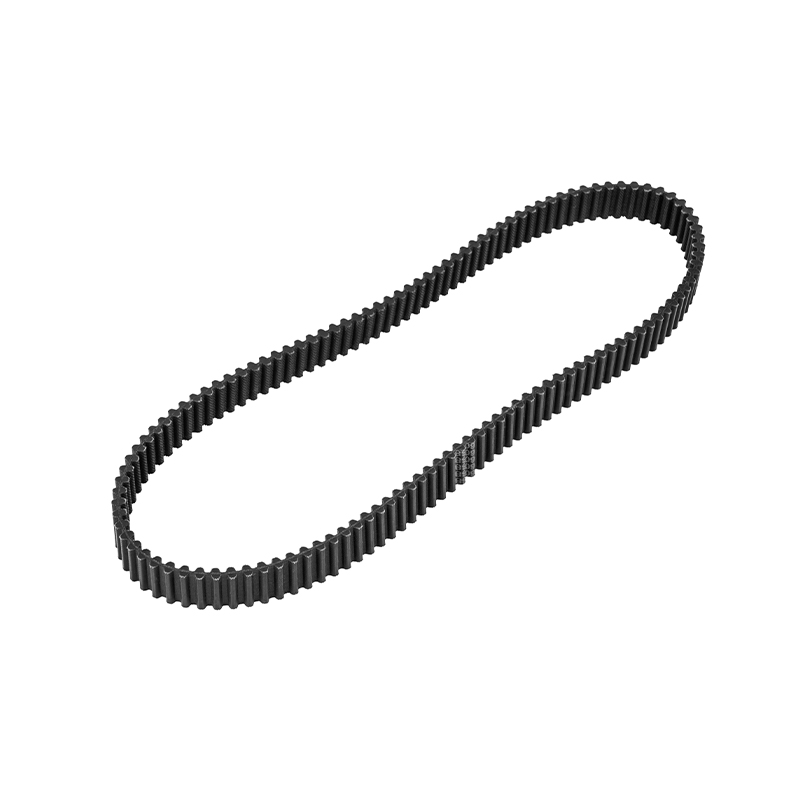
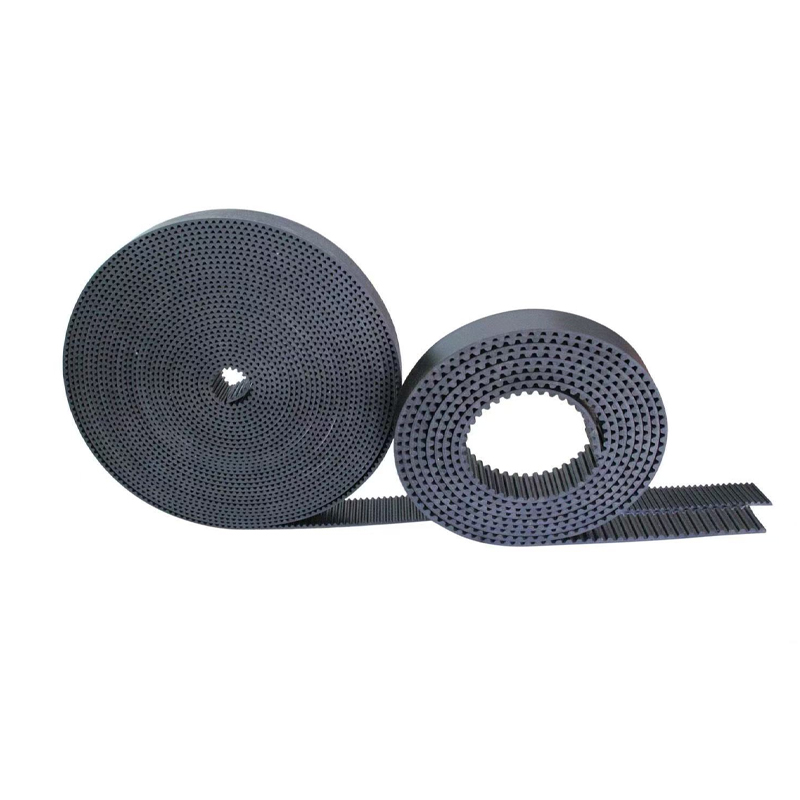
A standard rubber timing belt consists of three functional layers. The tooth and belt body are molded from a rubber compound — most commonly Neoprene (CR), Hydrogenated Nitrile Butadiene Rubber (HNBR), or Ethylene Propylene Diene Monomer (EPDM), depending on the temperature range and chemical environment. The tension member — the cord running lengthwise through the belt that carries tensile load — is typically fiberglass or aramid (Kevlar). The tooth face is often backed with a woven nylon fabric (PA 6.6) to reduce friction against the pulley and resist tooth root cracking.
HNBR compound is the current standard for automotive engine timing belts, offering continuous service to 130°C (266°F) and short-term peaks to 150°C (302°F) — critical for under-hood applications. EPDM is preferred where ozone and weather resistance matter, as in outdoor equipment and HVAC drives.
Polyurethane Timing Belt Construction
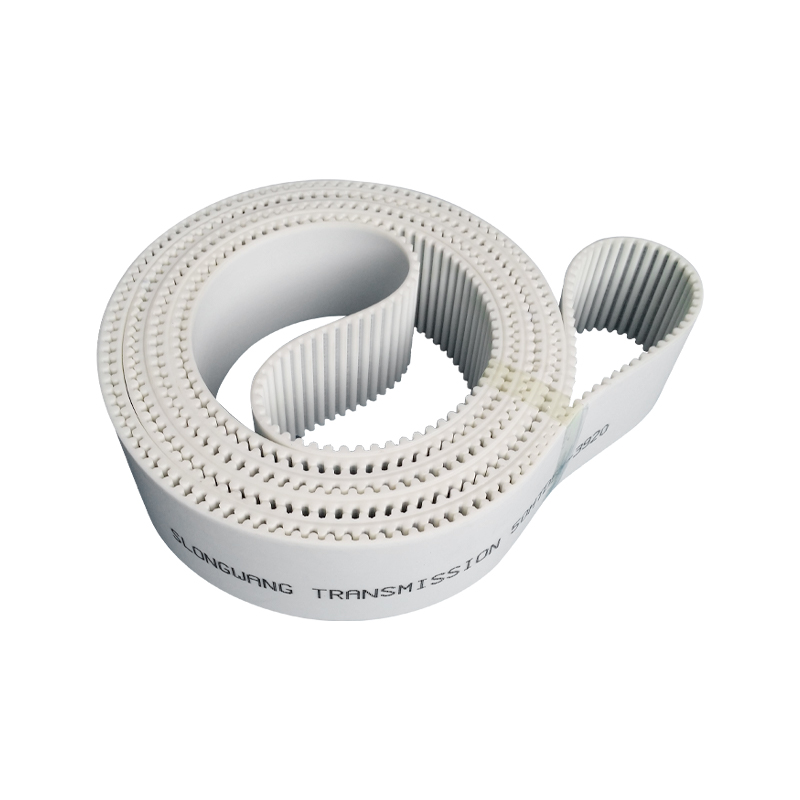
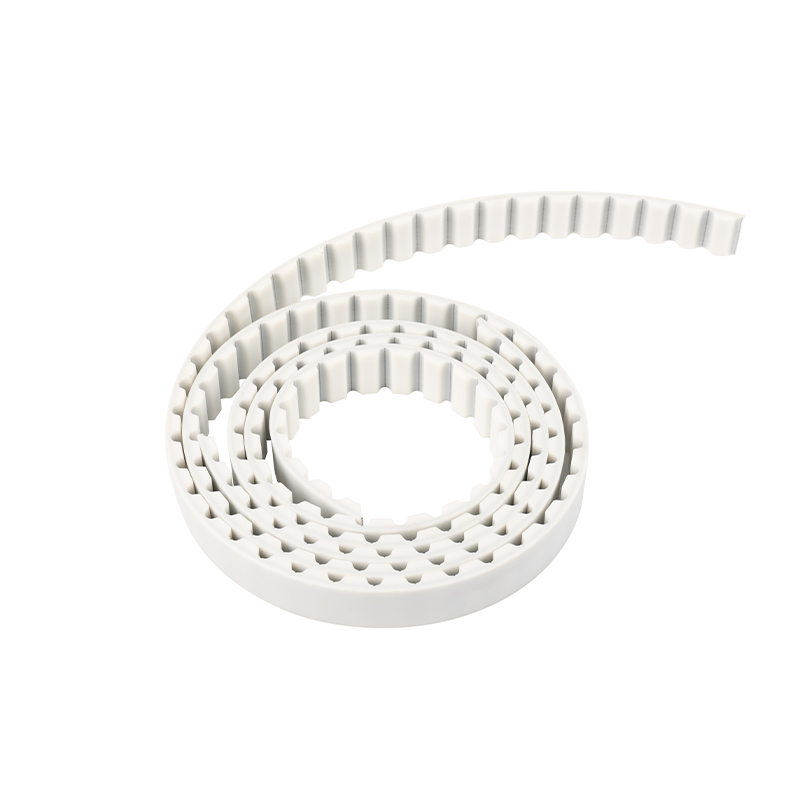
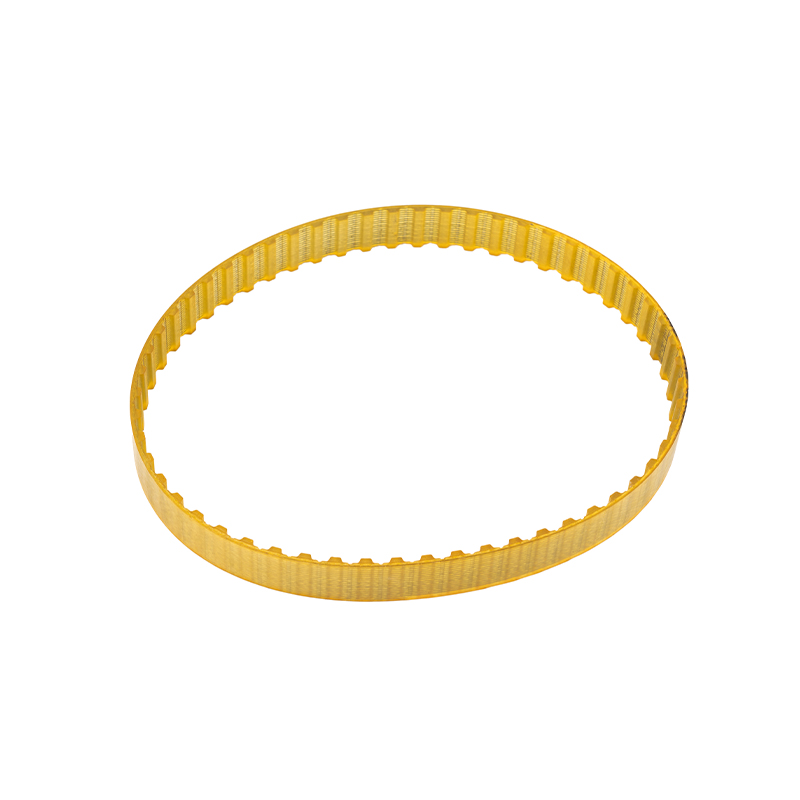
Polyurethane timing belts are manufactured by casting or extruding thermoplastic polyurethane (TPU) around a pre-tensioned cord. The tension cord is almost always steel wire or aramid fiber — steel for maximum tensile rigidity and positioning accuracy; aramid where weight or corrosion of the cord is a concern. Unlike rubber belts, polyurethane belts are typically manufactured as open-ended strips and welded or clipped to length in the field, which is a significant practical advantage in maintenance-intensive conveying and linear motion systems.
The polyurethane compound itself has a Shore hardness of 85–95A, making it noticeably harder and less compressible than typical rubber compounds (65–80A). This hardness is central to both the advantages and limitations of polyurethane belts.
Head-to-Head Performance Comparison
| Property |
Polyurethane Timing Belt |
Rubber Timing Belt |
Winner |
| Continuous temperature range |
−30°C to +80°C |
−40°C to +130°C (HNBR) |
Rubber |
| Dimensional / pitch stability |
Excellent (steel cord) |
Good (fiberglass cord) |
Polyurethane |
| Abrasion resistance |
Very High |
Moderate |
Polyurethane |
| Oil and fuel resistance |
Very High |
Moderate (HNBR), Low (CR) |
Polyurethane |
| Vibration / noise damping |
Low (harder compound) |
High (softer, elastic) |
Rubber |
| Hydrolysis resistance |
Low–Moderate (degrades in humid heat) |
High (EPDM, HNBR) |
Rubber |
| Tensile strength |
40–60 MPa |
15–30 MPa (compound only) |
Polyurethane |
| Field-weldable / open-ended |
Yes (butt-weld or clips) |
No (endless only) |
Polyurethane |
| Typical service life (industrial) |
3–7 years |
2–5 years |
Polyurethane |
| Unit cost (equivalent belt) |
20–50% higher |
Lower |
Rubber |
Direct performance comparison between polyurethane and rubber timing belts across ten key engineering and commercial criteria.
Temperature Performance: Rubber's Critical Advantage
Temperature range is the most frequently decisive factor in belt material selection, and it is where rubber timing belts hold a clear and significant lead.
Standard polyurethane (TPU) timing belts are rated for continuous operation between −30°C and +80°C (−22°F to +176°F). Above 80°C, the polyurethane begins to soften, tooth shear strength drops, and — critically — if any moisture is present, hydrolytic degradation accelerates sharply. In humid heat above 70°C, standard polyurethane belts can lose 30–50% of their tensile strength within 500–1,000 operating hours. Hydrolysis-resistant (HR) grades of TPU extend the useful upper temperature to approximately 100°C in humid conditions, but at a significant cost premium.
HNBR rubber belts operate continuously to 130°C, with intermittent peaks to 150°C. This is why every automotive engine timing belt — where under-hood temperatures routinely exceed 100°C — is made from HNBR rubber, not polyurethane. For food processing equipment that undergoes steam cleaning at 120–130°C, rubber belts (specifically EPDM or HNBR grades) are similarly the only viable choice.
At the cold end of the temperature range, both materials perform adequately down to approximately −30°C, but EPDM rubber retains flexibility and crack resistance to −50°C — important for cold-storage facilities, outdoor machinery in northern climates, and aerospace ground support equipment.
Dimensional Stability and Positioning Accuracy: Polyurethane's Core Strength
In linear motion, CNC positioning, and servo drive systems, the belt's dimensional stability under load is more important than temperature range. This is where polyurethane with steel cord tension members delivers a decisive advantage.
The steel cord used in polyurethane timing belts has a modulus of elasticity of approximately 200 GPa, compared to 70–80 GPa for fiberglass cord (used in most rubber belts) and 70–125 GPa for aramid cord. This means a steel-cord polyurethane belt stretches far less under the same tensile load — a critical property for applications where tooth-to-tooth positional accuracy of ±0.1 mm or better is required, such as CNC router axes, pick-and-place robots, 3D printer motion systems, and semiconductor wafer handling.
The harder polyurethane compound (85–95A Shore) also contributes to dimensional consistency: rubber's lower hardness (65–80A) means teeth compress slightly under load, introducing micro-level positional error that, while acceptable in power transmission, is unacceptable in precision indexing applications. For a system requiring repeated positional accuracy to 0.05 mm over 2 meters of travel, a polyurethane belt with steel cord is the engineering-correct choice.
Chemical and Environmental Resistance
Oil and Fuel Exposure
Polyurethane is highly resistant to aliphatic hydrocarbons (mineral oil, hydraulic fluid, diesel fuel), showing volume swell of typically less than 5% after prolonged immersion. Neoprene rubber swells significantly in oil (15–30% volume increase), which is why Neoprene-based belts are unsuitable for oil-splash environments. HNBR rubber is oil-resistant and used successfully in oil-lubricated engine timing applications — but polyurethane still outperforms HNBR in multi-chemical resistance scenarios.
Water and Humidity
This is polyurethane's most significant chemical vulnerability. Polyurethane undergoes hydrolysis — chemical breakdown by water — at a rate that accelerates sharply above 70°C and in alkaline environments (pH above 9). A standard polyurethane belt in a washdown food processing environment with caustic cleaning solutions (pH 12–14) and hot water above 60°C can fail in under 6 months. EPDM and HNBR rubber belts are essentially unaffected by water and alkaline cleaning agents, making rubber the mandatory choice in food processing, dairy, and pharmaceutical drive applications.
Ozone and UV Radiation
Neoprene and EPDM rubber compounds offer good-to-excellent resistance to ozone and UV. Polyurethane also resists ozone well. Standard Neoprene (CR) rubber, however, is vulnerable to prolonged UV exposure, causing surface cracking — a consideration for outdoor conveyors and solar tracking systems where EPDM or polyurethane is preferred.
Abrasion Resistance and Wear Life
Polyurethane's abrasion resistance is its most celebrated property. In standardized DIN 53516 abrasion testing, polyurethane elastomers exhibit volume loss of 25–50 mm³, compared to 100–200 mm³ for typical rubber compounds — a 3–6× improvement. In practical belt drive terms, this translates to significantly longer tooth life in applications with high tangential forces, dirty environments (metal chips, grit, sand), or frequent starts and stops that cause tooth surface sliding.
In conveyor systems handling abrasive bulk materials — grain, sand, metal parts — polyurethane timing belts typically outlast rubber equivalents by a factor of 2 to 4×. For a production line running 3 shifts per day, this difference means fewer belt changes per year, less unplanned downtime, and a lower total cost of ownership despite the higher unit price of polyurethane.
The nylon tooth facing fabric on rubber timing belts partially compensates for rubber's lower inherent abrasion resistance, but it wears through eventually — particularly in high-load, high-cycle applications — after which the underlying rubber compound degrades rapidly.
Noise, Vibration, and Dynamic Load Absorption
Rubber's viscoelastic character — the combination of elastic recovery and viscous damping — gives it a natural ability to absorb shock loads and attenuate vibration. In an engine timing system, this damping prevents resonance frequencies from amplifying into destructive belt oscillation. In industrial drives with high inertia loads and frequent speed changes, rubber belts reduce the shock transmitted to gearboxes, pulleys, and bearings.
Polyurethane's higher stiffness (Shore 85–95A vs. 65–80A for rubber) makes it a significantly poorer vibration absorber. In servo drive systems running at high speed with precise step-and-settle motion profiles, a polyurethane belt's higher stiffness can actually cause ringing (post-move oscillation) that increases settle time. This is a well-documented issue in high-speed pick-and-place machine design, where engineers must tune servo parameters differently depending on belt material. For applications with high shock loads or where belt noise is a design concern, rubber remains the better choice.
Open-Ended vs. Endless Belt: A Practical Difference
One practical difference that significantly affects maintenance strategy is belt form factor. Rubber timing belts are manufactured as endless (closed-loop) belts only. Changing a rubber timing belt requires either disassembling the driven shaft to slide the endless belt over it, or using a split pulley system — both of which can be time-consuming in complex machinery where the belt path runs through a frame or multiple shafts.
Polyurethane timing belts are available as open-ended strips sold by the meter and joined in the field using a thermal butt-weld or mechanical clips. This means the belt can be threaded around the existing shafts and pulleys without disassembly, then joined in place — a maintenance procedure that can reduce belt change time from several hours to 20–30 minutes on complex conveyor systems. For long conveyor runs and linear actuators requiring custom belt lengths, this field-jointing capability is a major operational advantage.
The weld joint is typically the weakest point of a polyurethane belt — a properly made thermal butt-weld achieves approximately 80–90% of the parent belt's tensile strength. For high-load applications, the welded section must be kept out of the tooth mesh zone if possible, and weld quality must be verified before installation.
Application-by-Application Selection Guide
Use this guide as a starting framework. Final selection should always be validated against the specific belt manufacturer's application data for the exact alloy, cord, and environmental conditions involved.
| Application |
Recommended Belt |
Key Reason |
| Automotive engine timing |
Rubber (HNBR) |
High temperature (100–130°C), oil splash, vibration |
| CNC machine axis / linear motion |
Polyurethane (steel cord) |
Positional accuracy ±0.1 mm, low elongation |
| Food processing (washdown) |
Rubber (EPDM / HNBR) |
Resistance to hot water, caustic cleaners, steam |
| Industrial conveyor (abrasive materials) |
Polyurethane |
3–6× better abrasion resistance, longer belt life |
| 3D printer / desktop CNC |
Polyurethane (steel or aramid cord) |
Dimensional accuracy, low stretch, availability |
| Oil-splash industrial gearbox |
Polyurethane or HNBR Rubber |
Both resist mineral oil; temperature determines final choice |
| Outdoor / high UV exposure |
Rubber (EPDM) or Polyurethane |
Both ozone/UV resistant; avoid standard Neoprene |
| Cold-storage (below −30°C) |
Rubber (EPDM) |
Retains flexibility to −50°C; PU becomes brittle |
| Pharmaceutical / cleanroom |
Polyurethane (FDA-grade TPU) |
Low particulate generation, FDA-compliant grades available |
| High-shock-load drive |
Rubber |
Viscoelastic damping absorbs shock; protects driven components |
Application-specific belt material recommendations based on the dominant performance requirement of each drive environment.
Cost Analysis: Unit Price vs. Total Cost of Ownership
Polyurethane timing belts carry a 20–50% higher unit price than equivalent rubber belts in most standard profiles (AT5, AT10, T5, T10, HTD, etc.). For a purchasing manager focused on unit cost, rubber appears to be the obvious choice. The total cost of ownership calculation often reverses this conclusion in industrial applications.
Consider a continuous-duty conveyor in an automotive parts assembly plant running 6,000 hours per year in an environment with oil mist and abrasive metal chips. A rubber timing belt requires replacement every 18 months at a belt cost of $150, plus 4 hours of labor at $80/hour = $470 per replacement. A polyurethane belt in the same application lasts 4 years at a belt cost of $220, plus 1 hour of labor (field weld) = $300 per replacement. Over a 4-year period: rubber costs $1,410 (3 replacements); polyurethane costs $300 — a saving of $1,110 per belt position on a line with 20 such drives means over $22,000 in savings, plus the value of avoided downtime.
This analysis does not hold universally — in lower-duty or easily-accessible drives, the shorter labor time difference narrows the TCO gap. In automotive engine applications where HNBR rubber is technically mandatory, cost comparison is irrelevant: rubber is the only viable material.
Common Tooth Profiles and Compatibility Considerations
Both polyurethane and rubber timing belts are manufactured in all major standardized tooth profiles. Tooth profile determines the load capacity, backlash, and noise characteristics of the drive — and a belt must always match the pulley profile exactly. The most common profiles found in both materials include:
- T-series (T2.5, T5, T10, T20): trapezoidal tooth profile, the most widely used profile in industrial drives; good load capacity, available in both PU and rubber
- AT-series (AT3, AT5, AT10, AT20): modified trapezoidal with wider tooth base for higher load capacity and better meshing; common in CNC and servo applications with polyurethane belts
- HTD (3M, 5M, 8M, 14M): curvilinear (rounded) tooth profile that distributes load more evenly across the tooth; popular in high-torque power transmission applications with rubber belts
- RPP / STPD (Powergrip GT): modified curvilinear profile with near-zero backlash; used in precision positioning with both PU and rubber depending on temperature requirements
- MXL, XL, L, H (imperial series): older trapezoidal profiles predominantly in rubber, widely used in North American industrial equipment and replacement applications
A critical compatibility note: a polyurethane belt must never be run on pulleys designed for a rubber belt of a different profile class, even if the pitch appears similar. The harder PU compound does not conform to minor profile differences the way rubber does, resulting in accelerated tooth wear, noise, and premature failure within hours of operation.
Summary: Which Timing Belt Material Should You Choose?
The choice between a polyurethane and a rubber timing belt comes down to four determining questions:
- Does the operating temperature exceed 80°C continuously? If yes — choose rubber (HNBR or EPDM). Polyurethane is not viable above this threshold without significant performance degradation.
- Is positional accuracy or low elongation the primary requirement? If yes — choose polyurethane with steel cord. No rubber belt matches steel-cord PU for dimensional stability in linear and servo applications.
- Will the belt be exposed to hot water, steam, or alkaline cleaning chemicals? If yes — choose rubber. Hydrolysis will destroy a standard polyurethane belt in such environments.
- Is the environment abrasive or oily (below 80°C)? If yes — choose polyurethane. Its superior abrasion and chemical resistance will deliver a lower total cost of ownership despite higher unit price.
When none of these factors is dominant — for example, in a clean, room-temperature, moderate-duty drive — either material is suitable, and the decision defaults to cost, availability, and whether a field-weldable open-ended belt offers a maintenance advantage. In all cases, consult the belt manufacturer's load rating charts with the actual operating conditions rather than relying on nominal specifications alone.


 Inquiry

 English
 中文简体
中文简体